CEE Professor is PI on NJBPU Report Offering a Path Forward for Marine Renewable Energy
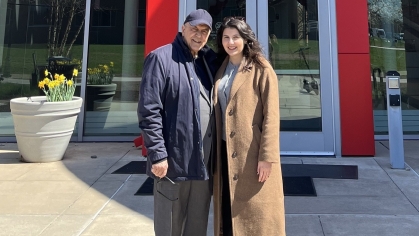
Ruo-Qian (Roger) Wang, an associate professor in the Department of Civil and Environmental Engineering (CEE), is the Principal Investigator (PI) for an extensive multidisciplinary report recently published by the New Jersey Board of Public Utilities, or NJBPU, that explores the potential of wave and tidal energy along the state's coastline.
The NJBPU-funded report directly aligns with the state's clean energy goals and legislative efforts including Bill S4129 recently passed by the New Jersey Senate to comprehensively assess New Jersey's tidal and wave energy resources and inform future clean energy strategies to establish New Jersey as the nationwide leader in ocean energy.

Wang's team of interdisciplinary Rutgers collaborators included co-PI Daniel Barone, a jointly appointed associate research professor in the Department of Marine and Coastal Sciences, Center for Advanced Infrastructeure and Transportation (CAIT), and the Department of Geography. Robert Miskewitz, a CEE colleague and research professor, was also a co-PI.
Recent graduates Moein Jamshidia, MS'25 and Alexander Roan BS'24, were co-authors on the report. Roan, who earned his BS in environmental science, is currently pursuing another undergraduate degree in civil engineering. "They are both outstanding alumni who contributed to this report during their time as students," reports Wang.
To complete the precise and detailed NJBPU study, Wang and his team devoted approximately two-and-a-half years of rigorous data collection, advanced modeling, and thorough analysis.
An Unprecedented Level of Precision
According to the report's executive summary, by evaluating technical feasibility, environmental constraints, and regulatory frameworks for responsible marine renewable energy development, it fills a critical gap in the assessment of tidal and wave energy until now.
While the report's foundational findings largely align with previous broader regional expectations, what sets this study apart, for Wang, is its unprecendented level of precision. "By looking beyond just basic technical feasibility to integrate complex environmental and economic factors, we offer a much more realistic and actionable roadmap for the future," he says.
Wang believes tidal and wave energy "hold strong potential for niche markets, particularly in coastal or off-grid areas where traditional grid access is limited and high-capacity power isn't strictly required."
When taking a longer view, he suggests that as technologies mature and costs decrease, these marine resources could serve as a valuable complement to New Jersey's broader renewable energy portfolio that includes solar and wind.
Wang is optimistic that small-scale pilot projects might be launched in the near future. "There is definitely tangible momentum," he states. "We're already seeing active interest from commercial developers looking to invest in New Jersey and New York coastal areas.
"With the right regulatory framework and continued state support, small-scale pilot projects at high-potential sites are a logical and exciting next step."
Looking forward, Wang describes the recent NJBPU report as a solid foundation for broader ongoing research. "Our team is focusing on more detailed analyses of localized environmental impacts, including fish collision risks, underwater noise propagation, sediment transport, and potential flooding risks."
To address these challenges, their novel "environmental co-design" methodology will integrate ecological constraints directly into the technical design from day one. Such environmental and technical co-designs will result in greater efficiency and sustainability. "Ultimately," Wang says, "we hope to secure future support to complement our computational models with real-world field measurements and proactive stakeholder engagement."